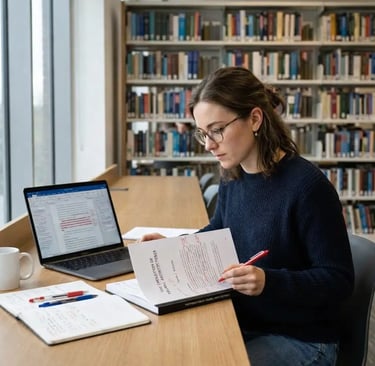
The Five Cs of Dissertation Editing
Ensuring your dissertation meets the highest academic standards requires a meticulous review process. Here is a breakdown of the "Five Cs" of dissertation editing:
Correctness
Correctness is the baseline of academic integrity, focusing on the technical accuracy of your writing. This involves more than just a simple spell-check; it requires a rigorous review of grammar, punctuation, and syntax to ensure the language is flawless. Beyond mechanics, correctness also extends to the accuracy of your data, the proper application of formulas, and the precise use of terminology specific to your field.
Clarity
Clarity ensures that your complex research is accessible and easy to follow. This step involves refining sentence structures to eliminate ambiguity and ensuring that each paragraph transitions logically to the next. The goal is to present your arguments so clearly that the reader can focus entirely on your findings rather than struggling to decipher your meaning. Editors often look for "signposting" language that guides the reader through the narrative arc of your study.
Conciseness
In dissertation writing, more is not necessarily better. Concise is the art of stripping away "fluff," repetitive phrases, and unnecessary jargon that can obscure your core message. By tightening your prose, you emphasize your most important points and respect the reader's time. A concise dissertation demonstrates that the author has a firm grasp of the material and can communicate sophisticated ideas efficiently.
Consistency
Building trust and professionalism throughout your work. This involves maintaining a uniform academic tone, ensuring that terms are used the same way from chapter to chapter, and strictly adhering to a specific style guide—such as APA, MLA, or Chicago. From the way you format your headings to the style of your in-text citations, every element must remain stable to prevent distracting the reader or appearing disorganized.
Completeness
Ensuring that no gaps remain in your research or presentation. An editor checks that every citation in the text has a corresponding entry in the reference list or bibliography, that all figures and tables are properly labeled, and that every research question posed in the introduction is answered in the conclusion. This final pillar guarantees that your dissertation stands as a comprehensive, self-contained contribution to your field of study.
Editing for APA Consistency
Maintaining consistency in APA 7th edition is about more than just matching your font; it’s about creating a predictable, professional environment for your reader. In a dissertation, this requires a "global" approach where every chapter follows the same logic for headings, serial commas, and citation formatting. For instance, if you use the Oxford comma in your abstract, it must appear in every list throughout the entire document. Consistency also extends to your "scholarly voice"—if you choose to use the first-person ("I conducted...") to describe your methodology, you should maintain that active voice rather than switching to the passive voice ("The study was conducted...") in later sections.
When editing for APA consistency, pay close attention to these specific areas:
Heading Hierarchy
APA 7 uses five possible levels of headings. Consistency means that every Chapter Title is a Level 1 heading (Centered, Bold, Title Case), and every major sub-section is a Level 2 (Flush Left, Bold, Title Case). If you skip a level or change the formatting halfway through your literature review, it disrupts the structural logic of your work.
The Reference-to-Text Match
One of the most common consistency errors is a mismatch between the in-text citations and the Reference list. If you cite "Smith & Jones (2022)" in Chapter 2, that exact spelling and date must appear in your bibliography. Professional editors often use a "cross-check" method to ensure that every name mentioned in the prose has a home in the references, and vice versa.
Numerical and Statistical Presentation
Consistency in how you present data is vital. APA 7 generally dictates that numbers zero through nine are written as words, while 10 and above are numerals. However, if you are presenting a precise measurement or a mathematical constant (e.g., $p < .05$ or $5$ kg), you must use numerals regardless of the value. Ensuring these rules are applied uniformly prevents your results section from looking cluttered or haphazard.


Citation Styles
Citation styles are standardized sets of rules for formatting research sources, ensuring consistency in academic writing. The most common styles are APA (social sciences/psychology), MLA (humanities/literature), and Chicago (history/arts), with choices dictated by academic discipline. Key differences lie in in-text citation (e.g., author-date vs. page number) and bibliography formatting.
Key Citation Styles and Usage
APA Style (American Psychological Association): Primarily used in education, psychology, and the sciences. Uses author-date format for in-text citations.
MLA Style (Modern Language Association): Used for literature, arts, and humanities. Emphasizes author-page number for in-text citations.
Chicago Manual of Style (CMOS): Used for history, philosophy, and religion. Often uses footnotes or endnotes instead of parenthetical citations.
Other Styles:
IEEE: Engineering and computer science.
Vancouver: Medicine and sciences.
ASA: Sociology.
ACS: Chemistry.
Key Differences in Formatting
Citation styles dictate the order of information (author, title, date) and punctuation.
In-text citations: APA uses (Author, Year), while MLA uses (Author Page).
Reference list: APA uses "References," MLA uses "Works Cited," and Chicago uses "Bibliography".
How to Choose a Style
The choice of style is almost always determined by the specific discipline, professor, or publisher's requirements.
Humanities: Use MLA.
Social Sciences/Education: Use APA.
History/Fine Arts: Use Chicago.
For specific formatting, resources such as the Purdue OWL are essential for examples of in-text citations and reference lists.
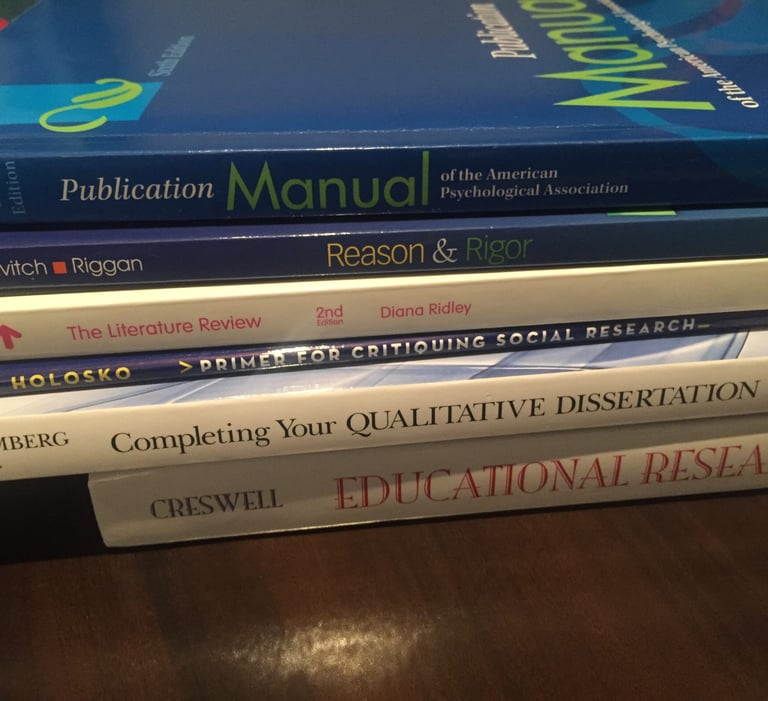
Dissertation Editing and Writing Services
We price our editing services based on the type of document, scope of work, and turnaround requests. We provide a foundational project management document detailing specific tasks, deliverables, timelines, and milestones for the project. Starting at $800 for up to a 60,000-word dissertation with a 14-day turnaround for the first edit. This is a top choice for Ph.D. students who prefer selecting their own editor, based on credentials, subject matter expertise, and editor capability. A foundational project management document detailing specific tasks, deliverables, timelines, and milestones for a project is included.
Important Considerations
Ethics and Legality: Professional proofreading and editing are generally permitted by universities and are not considered cheating. However, hiring someone to write your dissertation from scratch is typically considered a severe form of academic misconduct that can lead to expulsion.
Editing Certificates: Many services, like Enago and American Manuscript Editors, provide a certificate to confirm your work has been professionally reviewed for grammar and clarity.
Formatting Expertise: Most reputable services automatically include formatting for styles like APA, MLA, Chicago, and Harvard as part of their dissertation packages.
Students desiring a personalized choice of an editor with a PhD from the US. "The best life comes from an investment in knowledge." Rogan Philips
Benefits
Higher Grades: Professional editing can improve the overall quality, leading to better academic outcomes.
Reduced Stress: Helps students manage the final, often stressful, stage of their degree.
Improved Clarity: Ensures complex research is presented clearly and effectively.
Ultimately, professional dissertation editing is more than just a final polish; it is a strategic investment in your academic and professional future. By bridging the gap between rigorous research and exceptional communication, these services allow your intellectual contributions to shine without the distraction of technical errors or structural inconsistencies. Whether you are aiming for a seamless defense or preparing your work for future publication, expert refinement provides the peace of mind and scholarly precision necessary to transition from candidate to colleague with confidence. We believe that success starts with transparency. and comprehensive feedback on the quality, structure, and clarity of academic writing.
Professional dissertation editing and writing services provide specialized support for PhD and Master's students to refine their research into a submission-ready format. While editing services focus on grammar, structure, and adherence to style guides like APA or Chicago, our editing services often offer broader assistance, including topic selection and research support. We provide mentoring and editing services that deliver comprehensive, expert, and academic-level proofreading and structuring for final, high-stakes undergraduate and postgraduate projects. These services improve clarity, coherence, and adherence to specific style guides (e.g., APA), ensuring projects are polished and meet academic standards, while covering grammar, structure, and academic tone to increase the likelihood of success.